
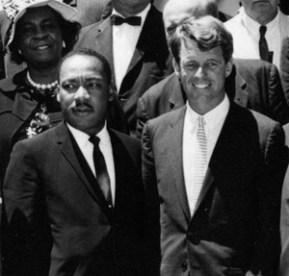
Martin Luther King and Senator Robert Kennedy
Every year around this time, Americans shower Martin Luther King, Jr. with love. Since 1986 his birthday has been a national holiday, providing all of us with a chance to learn more about him. School kids get exposed to the nature of African American life under apartheid in the South; symposia and talks are given discussing King’s legacy; King’s experiences are examined under the lens of current racial tensions; stores can have MLK Day sales; and the marketing opportunities are endless.
Get your “I Have a Dream” fortune told at a 1-800 number; make a cake with “Batter from a Birmingham Jail”; drink an “I’ve Been to the Mountaintop Dew”; if you’re lost, use the “Where Do We Go From Here” GPS; play in the “Edmund Pettus Bridge Tournament”; get a lottery ticket for the “SNCC Six” game, where you win if you rub off the names of a half-dozen leaders of the sit-in movement . . . and so it goes on. (As I write this, a TV ad has just come on for the “Joseph A. Bank Martin Luther King Day Sale” and I’ve learned that ESPN is airing a national MLK Day Special Edition NBA game).
Surely King deserves as much recognition as possible. He gave his life for the cause of civil rights and that legacy remains vital to discussions of race in the U.S., now more than any time in the past several decades in the aftermath of Ferguson, Baltimore, Charlottesville, and thousands of incidents of cops killing African Americans.
But national holidays serve another purpose as well—instilling a sense of national pride and, if needed, obscuring the past. We celebrate Christopher Columbus Day even though he perpetuated a genocide (a difficult reality to accept even for a proud Sicilian-American). King’s birthday has a political purpose as well. By celebrating it, the country engages in a weekend of self-congratulation and pride over its triumph over racial separation and violence. Continue reading




 Afflict The Comfortable (The Mind of Bob Buzzanco)